Counselling for Iranian Immigrants in Vancouver
Therapy for Iranian-Canadian and Iranian immigrant clients in Vancouver. Farsi & English. Immigration grief, intergenerational trauma, identity work.
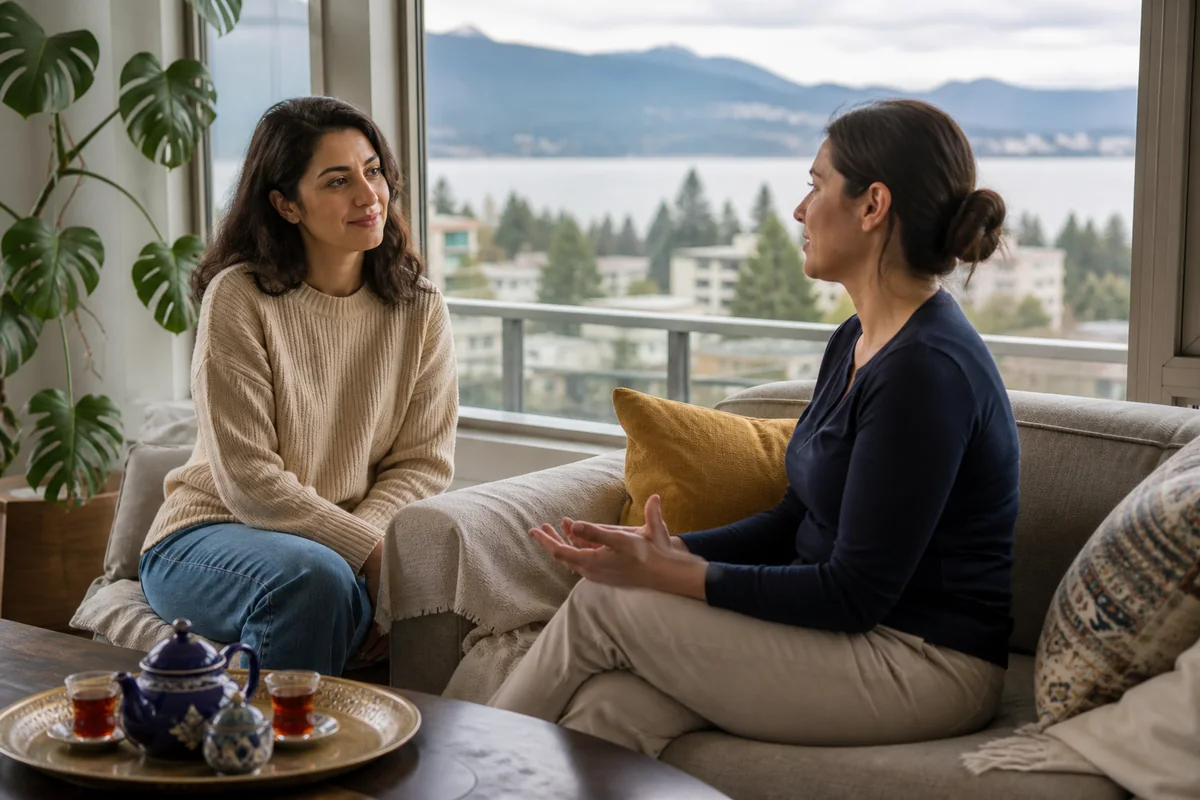
To leave Iran is to leave a country, a language, a sky, a family, a self. To arrive in Vancouver is to begin again — except no one really begins again. We carry everything with us, especially the parts we'd rather not.
There is no city in Canada with a longer or denser Iranian community than Vancouver. Tens of thousands of us live across the North Shore, Coquitlam, Burnaby, Richmond, and the surrounding regions, in waves stretching back to the 1970s and continuing in fresh waves through the 1980s, the 1990s, the 2000s and 2010s, and most recently the 2020s. Each wave brought its own losses and its own hopes, and each generation of Iranian-Canadians is now navigating, in private, what those losses and hopes have meant.
Baraka Ontology & Clinical Counselling is a counselling practice in West Vancouver built — among other things — to be a place where this conversation can happen properly, in Farsi or English, with clinicians who understand it from the inside. Our founder, Elham Zolfagharinia, is Iranian-born, completed her psychology training at Shahid Beheshti University in Tehran, and immigrated to Vancouver in 2014 before completing her Canadian credentialing as a Registered Clinical Counsellor (RCC). Her work spans the clinical and the cultural in ways that English-only Canadian therapists, however good, cannot fully reach.
We see Iranian-Canadian clients across every wave — those who came as children with their parents, those who came as young adults to study, those who came in their forties and fifties as professionals, those who came as refugees, those who came in the last three years from a country that has changed, and those who were born here to Iranian parents and are still navigating what that means.
This page is for you.
What we mean by "Iranian-Canadian therapy" — and why it's different
A therapist who shares your language and culture is not the same as a therapist who happens to speak Farsi. The difference is hard to articulate until you have experienced it.
Translation cost. Many Iranian-Canadians have done English-language therapy that helped intellectually and never reached the place where the wound actually lives. The body remembers in the language it was wounded in. Crying in your second language is different from crying in your
mother tongue. Anger expressed in English is not the anger you felt when you were eight. We work in Persian without translation cost, and we can shift between Farsi and English fluidly within a single session as the moment requires.
Cultural fluency. Iranian relational patterns, family structures, and emotional norms — taarof, the role of the family of origin in adult decisions, the place of the mother-son bond, the silence around divorce, the unspoken negotiations about money and status, the inherited weight of aabero (face/honour) — are not pathological. They are the texture of Iranian life. A Western-trained therapist working from individualistic Western assumptions will too often treat them as problems to be solved rather than realities to be navigated. We do not.
Historical and cultural context. Five decades of significant change in Iran — the 1979 revolution, the Iran–Iraq war, and the many subsequent waves of social, economic, and political shifts that have shaped successive generations — are part of the inner landscape many of our clients are carrying. We hold this context with care for clients across the political spectrum, without bringing our own political views into the room. Whatever your own relationship to these events, you are welcome here.
Diasporic literacy. The specific texture of being Iranian outside Iran — the longing, the survivor's guilt, the political conversations at family gatherings, the relationship to the homeland that you cannot return to safely, the children growing up Canadian who don't quite know what it cost — we live this too.
What we see, again and again, in our Iranian-Canadian clients
After many hundreds of hours with Iranian-Canadian clients, certain patterns recur. Not all of these will apply to you. They are common enough that we describe them here so that you may recognize what you are carrying.
Immigration grief
Most Iranian-Canadians, including those who chose to emigrate freely, are carrying unprocessed grief. The grief is rarely named as grief. It comes out as low-grade depression, as unexplained tearfulness, as somatic exhaustion, as the inability to be fully present with your Canadian life because part of you is still standing on a street in Tehran or Shiraz or Tabriz. Iranian immigration grief is layered:
- The loss of country, language, and the texture of daily life
- The loss of the professional self you were before recredentialing — the engineer who is a barista, the physician who is a medical assistant, the academic who is unemployed
- The loss of family — parents aging in Iran, siblings who didn't or couldn't leave, the funerals attended by Skype
- The loss of homeland as it existed in your memory — the particular Iran of the 1970s, or 1990s, that no longer exists in the country today
- The loss of futures — what your life was supposed to look like, who you were supposed to become, what you were supposed to be able to give your children
This grief responds well to therapy, but it requires being named first. Many of our clients tell us,
three or four months in, that they had not realized they were grieving until someone in the room helped them notice.
Pre-emigration experience
A meaningful portion of our Iranian-Canadian clients carry difficult experiences from before they left Iran. The Iran–Iraq war and its bombings, family losses, periods of economic and social hardship, and — for some — direct experiences of personal or family difficulty. For more recent immigrants, the upheavals of recent years have been part of the picture. These experiences vary widely person to person, and we work with whatever you are carrying without political framing or assumption. Trauma-informed therapy in Persian can do work that English-only trauma therapy often cannot reach.
(See: Trauma Therapy in West Vancouver →.)
Intergenerational trauma
Many of our clients did not live through war or revolution themselves but are carrying the unprocessed material of parents who did. This is the textbook definition of intergenerational trauma. It shows up as anxiety with no clear source, as patterns of overprotection or distance in parenting, as inherited fears, as a vague but persistent sense of unsafety even when nothing is actually wrong. Naming it as inherited rather than personal is often the first relief.
Identity disorientation
Iranian-Canadians of every generation are doing identity work, often without realizing it. The first generation: Am I still Iranian? Am I Canadian yet? Will I ever be? The 1.5 generation (those who came as children): I'm not fully either, and I never will be. The second generation: I was born here but I am not who my Canadian friends are; I am not who my Iranian relatives are; what am I? Therapy gives this question a place to be asked without the pressure to resolve it quickly.
Family system pressures
Iranian families are typically more enmeshed than Canadian norms expect. This is not pathology. It is culture. But for adult Iranian-Canadians trying to build their own lives in a context that values individuation, the gap between the family system you came from and the life you're trying to build can produce significant suffering. We work with this carefully — not by trying to make you "more Canadian" or "less Iranian" but by helping you develop the inner clarity to navigate both with less collapse and less guilt.
Recent immigration and the weight of "watching from afar"
For clients who immigrated more recently, or whose families and friends are still in Iran during a period of significant change, there is often a particular weight — concern for loved ones back home, the cognitive load of following events from a distance, and a complicated relationship to a country in flux. We hold whatever you are carrying about your homeland, regardless of your political views, without bringing our own positions into the room. We have clients across the full range of perspectives on what is happening in Iran, and our work is the same with each: to make space for what you feel, what you fear, what you long for, and what you cannot easily say to anyone else.
Many of these clients describe being unable to talk about Iran with their non-Iranian friends, partners, or therapists without exhausting themselves explaining context. With us, they don't have to.
The cost of being the family success story
Many of our Iranian-Canadian clients are the family member who "made it" in Canada — the one who got the credentials, the career, the home. They send money home. They host visiting relatives. They are the proof of the family's sacrifice. The weight of that role, especially when it conflicts with their own needs for rest, retreat, or different kinds of life, is something we hold often in the work.
Shame about therapy itself
In some Iranian families, going to therapy is still associated with weakness, shame, or "real" psychiatric illness. Many of our clients come quietly, do the work, and never tell their parents. We hold that as a confidential and reasonable choice. Therapy is not a public statement. It is private work for your own life.
How we work
Our Iranian-Canadian work spans the full Baraka practice — depth-oriented, integrative, evidence- informed:
- Individual therapy for adults navigating any of the above
- Couples and family work — including mixed-culture couples, cross-cultural in-law dynamics, and Persian-speaking couples whose work is best done in Farsi
- Trauma therapy for war, political, and pre-emigration trauma, and for intergenerational material
- Postpartum support for new Iranian-Canadian mothers far from the forty-day tradition of family care
- Bilingual sessions — Farsi, English, or moving between both as the work calls for
We work in person at our Ambleside office and online across British Columbia.
What therapy looks like
Most Iranian-Canadian clients begin with weekly sessions and continue weekly through the early phases of work — typically the first three to six months — before shifting to biweekly. Some clients come for a particular crisis or transition and complete the work in three to six months; others stay for a year or more, especially for deeper trauma, identity, or intergenerational work.
You are not asked to come "ready" to talk. You are asked to come. The first session is mostly listening.
The bilingual community we are part of
Beyond the clinic, Elham contributes to broader Persian-language mental health conversation through writing, teaching, and the @Elhampsych Telegram channel — a Persian-language
community for psychological education and reflection. Many clients find us through that work. The clinic itself is a separate, private, professional space.
Frequently asked questions
Do I have to speak Farsi to come? No. Many of our Iranian-Canadian clients — especially those who came young or were born here — are more comfortable in English or want to do their work in English. We hold both languages and can shift between them.
Will my parents find out? No. We are bound by clinical confidentiality. We do not contact family members without your written consent. Therapy is your private work.
Can I come if I'm dating or married to a non-Iranian? Yes — we do significant work with mixed-culture couples and individual clients in those relationships. The cultural translation work between partners is often the heart of what's needed.
Can I bring my partner who doesn't speak Farsi? Yes. We can do couples work bilingually, or in English if that's what works.
Is therapy covered by extended health benefits? Most BC extended health plans cover sessions with RCC counsellors. We provide receipts. (See: Insurance & Fees →.)
Do you work with clients across Canada? Our scope of practice is BC-licensed. For Iranian- Canadian clients in other provinces, we can sometimes consult, but ongoing therapy must be with an appropriately licensed local clinician. We're happy to refer where we can.
Are sessions in Farsi the same price as English? Yes.
A closing note
If you are Iranian and you are reading this in English because you are not sure whether to come, please know that you do not have to know what is wrong before you reach out. Most of our Iranian- Canadian clients couldn't have named what they were carrying before they began. The naming is part of the work.
- Book your free 15-minute consult → — phone or video, in Farsi or English Or call (236) 455-6306 Email contact@barakaocc.com
1571 Bellevue Avenue, Suite 210, West Vancouver, BC V7V 1A6 — and online across British Columbia.
همراهتان هستیم. (We are with you.)
Frequently asked questions
How do I start with Iranian Immigrants?
Start with a consult so the care team can understand fit, urgency, language, modality, and next steps.
Is this page medical advice?
Baraka pages are educational and navigation-focused; they do not replace diagnosis, crisis support, or emergency care.