Witness Fatigue — When Caring About Your Country Is Breaking You
Watching your homeland from abroad takes a real toll. A clinical look at witness fatigue, diaspora exhaustion, and how to keep caring without coming apart.
A note on tone: this article is written for Iranian-Canadians across the political spectrum. Baraka serves clients who hold a wide range of views on Iran — pro- government, pro-opposition, secular, religious, monarchist, reformist, apolitical. We do not take political positions in our clinical work. The psychological dynamics described below apply regardless of where any given person stands politically.
There is a particular exhaustion I see often in Iranian-Canadian clients — and Iranian-Americans, and Iranian-Europeans, and the broader diaspora. It is not depression, exactly, though it can lead there. It is not anxiety, exactly, though it usually carries anxiety. It is not burnout from work. It is something more specific: the cumulative cost of caring deeply about events in a country you cannot reach from a distance you cannot close.
In trauma literature, this is sometimes called witness fatigue, vicarious trauma, or compassion fatigue — terms developed for therapists, journalists, and humanitarian workers who carry exposure to suffering they cannot directly fix. The terms apply, with adaptation, to the diaspora condition.
This article is for any Iranian-Canadian (or other diaspora reader) who has recognized that caring about their country is, currently, breaking them — and who wants to find a way to keep caring without coming apart.
What's actually happening
The nervous system was not built for the level of suffering exposure that contemporary news consumption delivers. Our threat-response systems evolved for immediate, local threats — threats we could fight, flee, or address. Watching events thousands of kilometres away that we cannot directly affect activates the same nervous-system responses without the same resolution.
For diaspora witnesses specifically, several layers compound the basic news-overload problem:
The events are not abstract. They concern your country, your people, sometimes your family. The footage is from streets you have walked. The faces look like faces you know.
You have a relationship to what is happening that is not the same as a foreign observer's. Your relationship is layered with personal history, family connections, identity, language, the particular ways your life has been shaped by the country in question.
You cannot directly help. The traditional response to seeing suffering — go to it, be present, contribute physical labour or care or witness — is unavailable across borders. The advocacy work that is available (donations, social media, political engagement, contacting representatives) does not always feel commensurate to the situation.
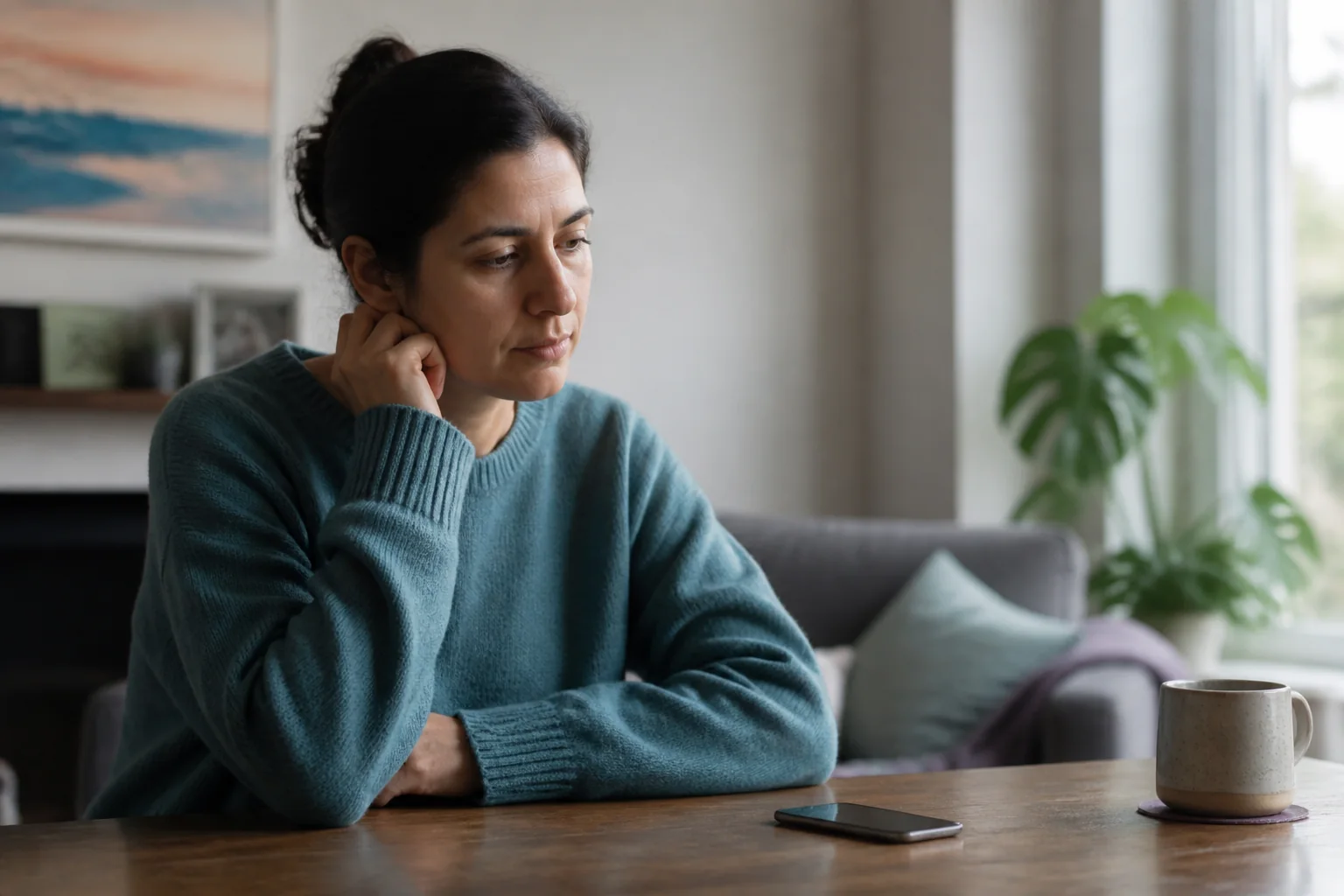
The exposure is constant. Pre-internet, diaspora communities received news from home through letters, occasional phone calls, eventual visits. Now the news is on your phone, at all hours, in real time. The nervous system never gets to settle.
Your community is also affected. The friends and family you would normally turn to for relief are also affected. You cannot fully release the weight to them because they are carrying their own version of it.
The political landscape is divisive. For Iranian-Canadians, conversations about Iran can fracture friendships, families, and communities depending on political alignment. The diaspora is not a unified emotional support system; it is itself a contested space.
The personal weight intensifies during specific events. Wars, protests, economic crises, natural disasters — these moments produce acute spikes on top of the chronic baseline.
How it shows up
In my practice, witness fatigue presents in recognizable patterns:
- Sleep disrupted in ways that track with news consumption rhythms
- Anxiety and rumination focused on Iran-related material — what's happening, what might happen, who is safe, what you should be doing
- Difficulty being fully present in your local life because some attention is always tracking events elsewhere
- Compassion fatigue — diminished emotional response to news that should still feel acute, sometimes followed by guilt about the diminished response
- Survivor's guilt — the underlying sense that you are safe and others are not, and that this is somehow morally questionable
- Social media as compulsion — checking, scrolling, doom-cycling through Iran content for hours
- Avoidance — the opposite presentation, where you have stopped consuming news entirely and feel guilty about that too
- Friction with your partner over how much news you consume and how much you talk about it
- Friction within friendships and the community over differing political views
- Periods of intense engagement followed by collapse and disengagement, cycling
- Physical symptoms — gut issues, headaches, muscle tension, immune dysregulation
- A particular kind of meaninglessness in your local daily life when the global situation feels urgent
The bind
Witness fatigue puts you in a particular bind. The two obvious responses both have costs.
Stay highly engaged. Continued consumption of news, advocacy, conversation, vigil. This honours the events and your connection to them. It also depletes you, makes you less effective in your own life, and over time can produce burnout that prevents sustained engagement.
Disengage. Cut news consumption, step back from advocacy, focus on your local life. This protects your nervous system and capacity. It also produces guilt, can feel like betrayal of those still suffering, and can create distance from your community and your own identity.
Both extremes are unsustainable. The work is finding a sustainable middle that honours both your connection to events and your need to actually function.
What helps
In my practice, what I see working over time involves several strategies:
Bound the consumption. Designate specific windows for news engagement — morning brief, evening update — rather than constant background scrolling. The nervous system can metabolize bounded exposure. It cannot metabolize unbounded exposure.
Choose your sources deliberately. Quality, slow journalism over real-time social media. A few trusted voices over the algorithmic firehose. The depth of understanding you get from one good piece of analysis usually exceeds what you get from hours of doom-scrolling.
Distinguish witness from action. Witnessing — the work of staying informed, of caring, of not letting events go unseen — is real work and it has limits. Action — donations, advocacy, sustained engagement on specific issues — is different work. Most witness fatigue comes from over- witnessing without the corresponding action that gives the witnessing somewhere to go.
Find your specific contribution. Most diaspora members cannot end the suffering of an entire country. Most can do something specific — support one organization, mentor one newcomer, write one piece, support one specific case. Channeling some of the energy into a specific bounded contribution gives the witness work a destination.
Honour grief explicitly. Some of what witness fatigue carries is unprocessed grief — for what is happening to your country, for who has been lost, for the version of the homeland that no longer exists. Naming this as grief, and grieving it consciously, allows the material to move.
Build the local infrastructure that allows the distant work. Strong marriage, close friendships, community, regular movement, sleep, time outdoors — these are not distractions from caring. They are the foundation that lets you keep caring.
Connect with community that holds the witness work alongside you. Iranian-Canadian community gatherings, advocacy groups, cultural organizations, faith communities (where applicable) — being in physical proximity with others who carry this material reduces the loneliness of witness work substantially.
Address the specific marital strain. When one partner is more affected by Iran-related material than the other, marital friction often develops. Therapy that understands the dynamic can prevent the slow erosion this otherwise causes. (See Couples therapy →.)
Consider therapy specifically for vicarious trauma. Some of what diaspora witnesses carry meets clinical criteria for vicarious trauma. Trauma-informed therapy can help process the material rather than carrying it as chronic activation.
Allow seasons. Some periods of life and history will require more witness work; others will allow for more local focus. The diaspora condition is lifelong, and the engagement with it can shift across seasons without betraying anything. The work is sustainable engagement, not constant maximum engagement.
A specific note on social media
Social media — particularly Twitter/X and Instagram during periods of crisis — has, in my clinical observation, been one of the most damaging forces in Iranian-Canadian mental health over the past several years. The algorithmic delivery of crisis content, the parasocial intensity of emotional engagement with strangers' suffering, the political polarization, the doom-cycling that the platforms are designed to produce — these reliably produce nervous-system effects that meet criteria for trauma exposure.
If you are using social media as your primary source of Iran-related information, I would gently suggest experimenting with a substantial reduction. The first week is hard. The second week is usually a relief. Quality of life and capacity to engage meaningfully with the actual situation typically improves significantly.
When to come in
If you are recognizing yourself in this article — if witness fatigue has crossed from manageable into clinically significant — please consider therapy.
Counselling for Iranian-Canadian clients at Baraka holds these specific layers with both clinical depth and cultural understanding. We do not take political positions, and we work with clients across the full range of views. Available in English and Farsi, in person at our Ambleside office and online across BC.
- Book a free 15-minute consultation → Or call (236) 455-6306 Email contact@barakaocc.com
همراهتان هستیم. (We are with you.)