What Your Parents Carried — Intergenerational Trauma in Iranian Families
The trauma your parents survived can reach you through attachment, family environment, and epigenetic transmission. A clinical look at what Iranian-Canadians often inherit.
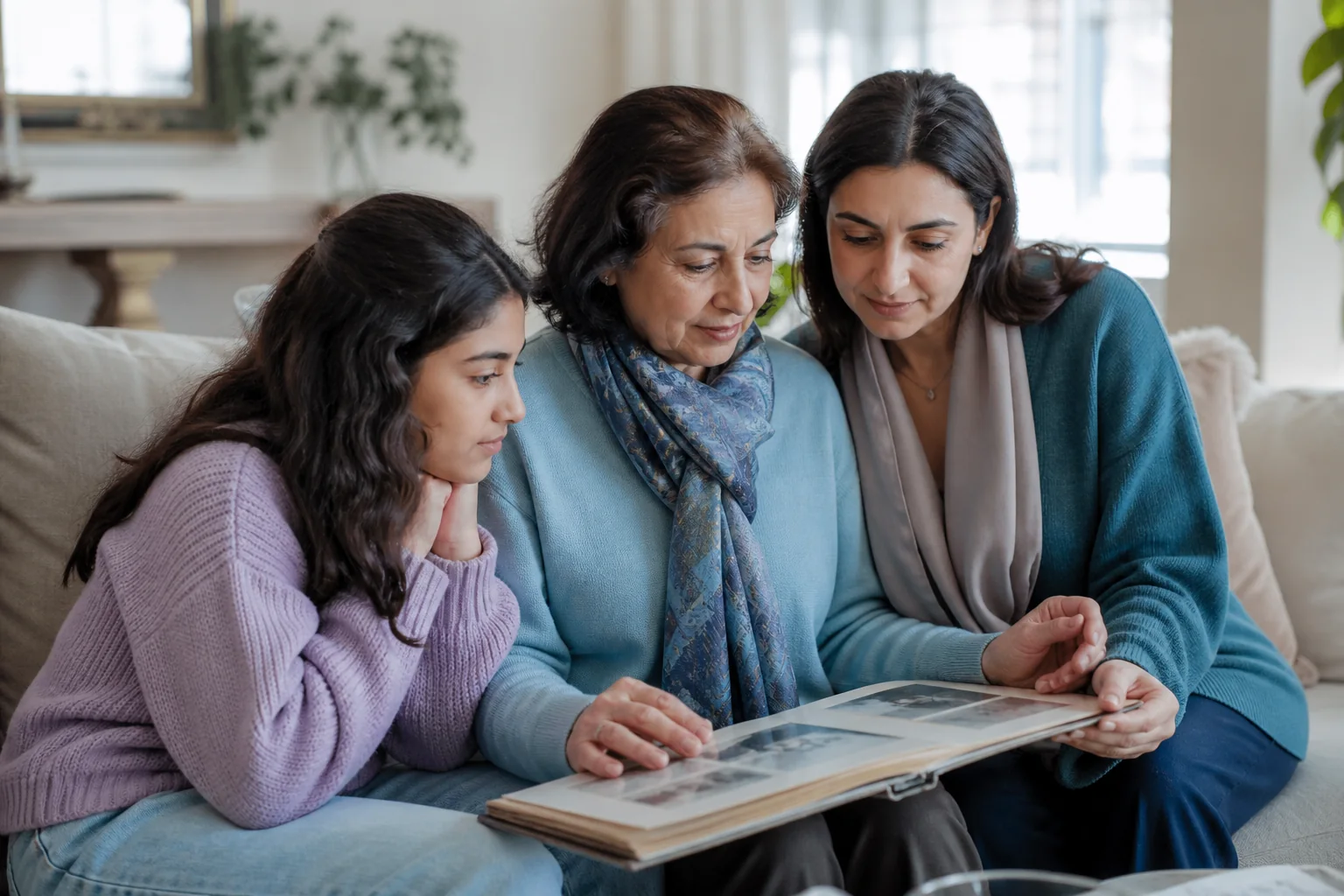
A client came to me a few years ago with what looked, from the outside, like ordinary high- functioning anxiety. She was thirty-two, second-generation Iranian-Canadian, born in Vancouver. She had a successful career, a healthy marriage, no obvious trauma history. She had been doing CBT for two years and had not gotten meaningfully better. She came to me because someone had told her my work was different.
In our fourth session, while she was talking about something unrelated, her body went still. She told me she had a sudden, vivid sensory memory of an apartment in Tehran she had never lived in. The smell of it. The feel of the tile under bare feet. The light coming through a particular window. Her grandmother sitting somewhere just out of view. She had never been to that apartment. Her mother had described it once, twenty years ago. But her body had it.
This is intergenerational trauma. It is real, increasingly understood scientifically, and one of the most under-recognized clinical realities in our work with the children and grandchildren of trauma survivors.
What we mean by intergenerational trauma
Intergenerational trauma — also called generational trauma, transgenerational trauma, or inherited trauma — refers to the transmission of trauma effects from one generation to the next, even when the second or third generation did not directly experience the originating events.
The transmission happens through several mechanisms:
Attachment patterns. Children of traumatized parents are raised by adults whose nervous systems were shaped by trauma. The traumatized parent, however loving, may be hypervigilant, emotionally avoidant, prone to flooding, or numbed. The child's nervous system is shaped, in early development, by the parent's regulated and dysregulated states. This is not parental failure; it is biology.
Family environment and unspoken rules. Households shaped by trauma have particular features — what can be talked about, what cannot, where the silences live, what triggers protective reactions. Children absorb these rules without being taught them. They become the air the family breathes.
Specific behavioural and emotional patterns transmitted through modeling — anxiety responses, hyper-vigilance, the relationship to risk, the relationship to authority, the relationship to safety.
Cultural and historical narrative carried in the family's stories, silences, and reactions to current events.
Increasingly recognized: epigenetic transmission. Research over the past two decades has shown that severe trauma can produce epigenetic changes — modifications to how genes are expressed, without changing the genetic code itself — that can be passed to offspring. Studies of Holocaust survivors' descendants, descendants of the Dutch Hunger Winter, descendants of trauma survivors more broadly, have shown measurable changes in stress response systems in people who never experienced the original trauma.
This is not metaphor. It is biology.
What Iranian families often carry
For Iranian families specifically, the historical material that may have shaped the family system is significant. The decades around the 1979 revolution and the Iran-Iraq war (1980–1988) produced extensive trauma — for those who lived through them, for the families displaced, for those who lost loved ones, for those who fled, for those who stayed. Many of my clients' parents and grandparents lived through these years. Many do not talk about them. Many cannot.
The specific material commonly transmitted through Iranian families includes:
War trauma. Bombings, mobilization, missing or martyred relatives, the lived experience of a country at war during formative years. Many of my clients' fathers were boys during the Iran-Iraq war and have never fully spoken of what they saw.
Displacement trauma. The trauma of leaving — sometimes urgently, sometimes incrementally — homes, professions, family networks, identities. Even for families who immigrated under relatively stable conditions, the displacement carries cost.
Political trauma. For families directly affected by political events — imprisonment, persecution, executions, surveillance — the silence around what happened is often a generation deep, and the children and grandchildren absorb the silence's weight without knowing what it surrounds.
Loss trauma. Family members lost to war, illness, exile, separation. The funerals not attended. The cousins who never made it.
Pre-revolutionary loss. For families who lived through the cultural and structural upheaval, the grief for a country and a way of life that no longer exists in the same form.
I want to be clear: I am not here making any political claim about any of these events. I am noting their psychological consequence. The same nervous-system effects we would expect from any major collective trauma show up in Iranian family systems.
How it shows up in second and third generation
In my second-generation Iranian-Canadian clients — born or raised in Canada — the inherited material often shows up as:
Anxiety with no clear personal source. The client has had an objectively safe life, and yet carries a baseline anxiety their non-immigrant friends do not. Their nervous system is operating on settings calibrated for a much more dangerous environment than the one they actually live in.
Hypervigilance about family safety. A particular preoccupation with parents' health, with siblings, with relatives in Iran. The implicit knowledge that family can be lost.
Difficulty fully feeling safe. Even when objectively safe, a felt sense that something is about to happen.
Conflict around identity. Feeling neither fully Iranian nor fully Canadian, with the inheritance of a country they may have never lived in shaping who they are.
Emotional restriction in particular areas. Topics that the parents could not discuss show up as topics the child cannot fully access — sometimes for reasons the child cannot articulate.
The success-story pressure. Inherited not as words but as embodied knowing — this family's survival depends on me succeeding visibly.
Somatic symptoms — the body holds what the family system could not name. Headaches, gut issues, chronic muscle tension, sleep dysregulation in the absence of clear individual cause.
A particular kind of seriousness. Many second-generation Iranian-Canadians describe themselves as having grown up "older than" their non-immigrant peers — more aware of mortality, more aware of fragility, more burdened by the weight of family.
What helps
The work of intergenerational trauma is delicate. We are not trying to dig up the parents' stories or extract material that wasn't ours to know. We are working with what we, the second or third generation, actually carry.
The work usually involves:
Recognizing the inheritance. Naming what came through the family system. This is often the most clarifying step — once a client recognizes that the anxiety they have been treating as a personal flaw is partly inherited, the relationship to it changes.
Honouring the parents' survival. Whatever was transmitted came alongside the survival itself. The parents who carried the trauma also carried the family. Working with this material is not blaming them. It is, in many cases, the work of finally seeing them.
Differentiating their material from our own. The anxiety I carry that came from my mother's nervous system is real and mine to work with — but it is not mine in the same way that anxiety I generated through my own experiences is. Differentiation allows the work to be more accurate.
Body-based work. Somatic approaches are particularly useful here, because much of what is transmitted lives below conscious memory. The body remembers what the family did not say.
Parts work. Internal Family Systems often surfaces parts of the self that are clearly carrying inherited material — parts that are vigilant, parts that protect, parts that grieve for things they never directly lost.
Cultural and ancestral work. For some clients, contemplative or ancestral practices — drawn from their own tradition — become part of the integration.
The question of whether to talk to the parents. A common question, with no universal answer. Sometimes the work makes a conversation with parents possible that wasn't possible before. Sometimes the work allows you to release the need for that conversation. Both are valid outcomes; we go where the work goes.
A note on cultural sensitivity in this work
Intergenerational trauma work with Iranian-Canadian clients should not pathologize the family. Iranian families carry survival, resilience, devotion, and richness alongside whatever trauma they hold. Working with the inherited material is not about diagnosing your parents or blaming a culture. It is about acknowledging what is real, naming what was carried, and finding your own way of being shaped by it without being run by it.
When to come in
If you have recognized yourself in any of this — particularly if you are second or third generation and have wondered why anxiety, hypervigilance, or a particular weight seems to be in you with no clear personal cause — therapy can help.
Counselling for Iranian-Canadian clients at Baraka is depth-oriented, somatic-aware, and culturally fluent. Available in English and Farsi, in person at our Ambleside office and online across BC.
- Book a free 15-minute consultation → Or call (236) 455-6306 Email contact@barakaocc.com