The Iranian Mother-Son Bond Is Not Pathology
Western therapy often pathologizes Iranian mother-son closeness as enmeshment. A culturally-aware look at what's actually happening — and the real tensions worth working with.
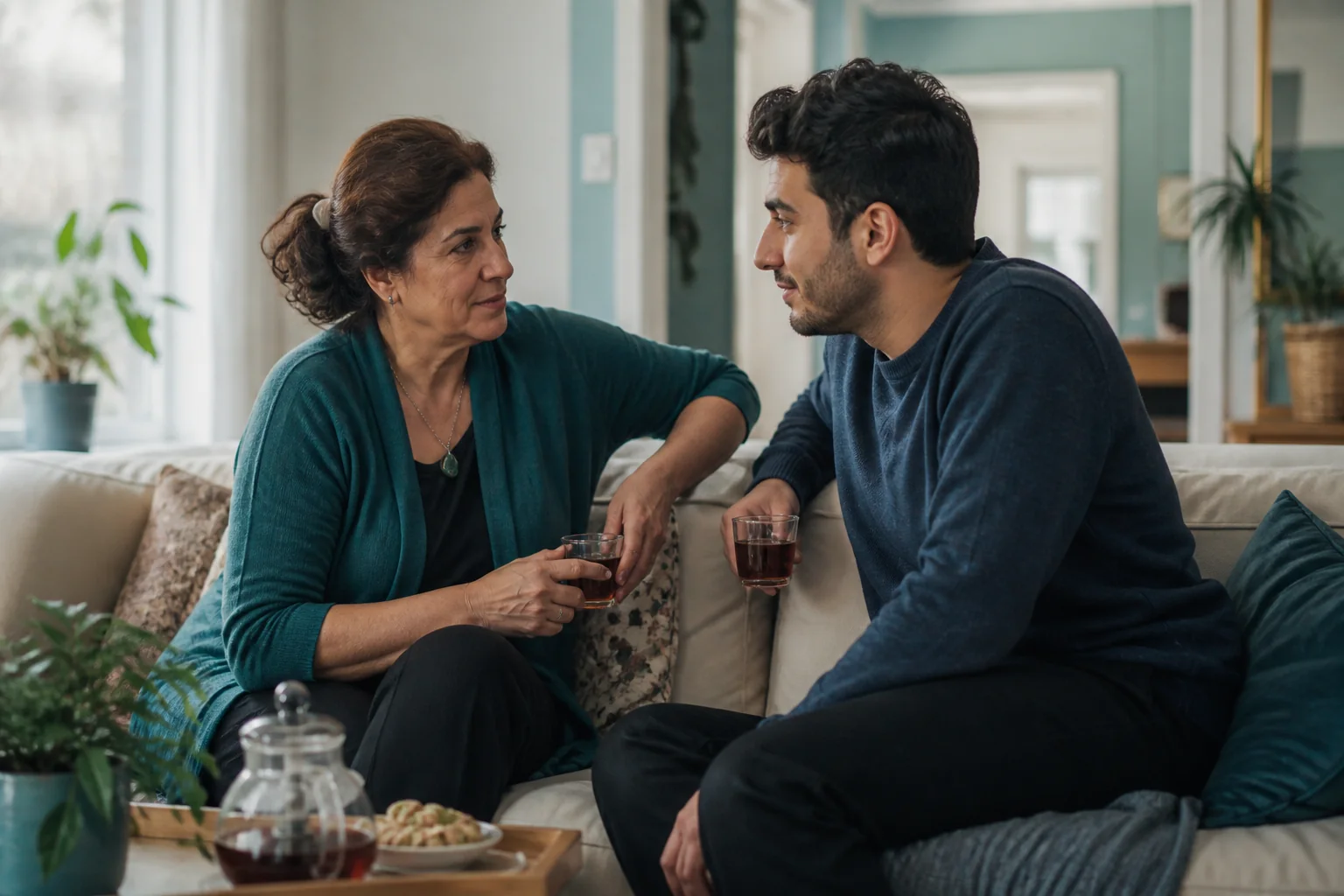
A Canadian-born wife of an Iranian-Canadian husband sat in my office and described, with rising frustration, the relationship between her husband and his mother. He calls her every single day. They talk for an hour. He visits her four times a week. When she's not feeling well, he goes over and stays with her until she's asleep. When we make decisions, he wants her input. When we travel, we have to call her every day. I've read all the articles — this is enmeshment. This is unhealthy. I want him to set boundaries. He won't.
I have heard versions of this story dozens of times — sometimes from non-Iranian partners frustrated with what they read as dysfunction, sometimes from Iranian-Canadian sons feeling pulled between cultural worlds, sometimes from Iranian mothers themselves wondering why what was once normal closeness is now described, by their daughters-in-law, as pathology.
This article is about what is actually happening in Iranian mother-son relationships, what Western frameworks like "enmeshment" miss, and where the real tensions worth working on actually live.
The cultural baseline
Iranian families, like many family systems across the Middle East, South Asia, and Mediterranean cultures, organize around a different relational structure than the Western-Anglophone individuation model. In the Western-Anglophone model — the model most therapy training is built on — adult children are expected to individuate from their families of origin around late adolescence and to be psychologically and practically independent through adulthood, with periodic family contact as elective.
This is not how most Iranian families work. The expected structure includes:
- Lifelong daily or near-daily contact with parents
- Significant input of parents into adult children's major decisions (marriage, career, where to live, how to raise children)
- Practical interdependence — adult children often live near parents, support them in caregiving, and expect to be supported during life transitions
- Emotional closeness that the Western frame might call merger but the Iranian frame would call love
- Particular intensity in the mother-son relationship, often the most emotionally significant relationship in a son's life until and sometimes after marriage
This is not pathology. This is a different relational architecture. Calling it "enmeshment" applies a framework developed for one cultural context to a phenomenon shaped by another, and the diagnosis fails.
Why "enmeshment" doesn't fit
The clinical concept of enmeshment, developed by Salvador Minuchin in the 1970s, describes a pattern within a family system where boundaries between members are so blurred that individuals cannot function autonomously. It is a pathological condition with measurable consequences — high anxiety, difficulty with adult relationships, identity confusion, emotional dysregulation.
The reason "Iranian mother-son closeness" so often gets misread as enmeshment is that the external behaviours can look similar. Daily contact. Emotional intensity. Mother's input into adult decisions. Visible interdependence.
But the outcomes don't match. Sons in healthy Iranian mother-son relationships are typically:
- Capable of stable adult intimate partnerships
- Successful in independent professional life
- Possessed of a clear sense of identity
- Emotionally well-regulated
- Able to make decisions, including decisions their mothers don't agree with
These are not the outcomes of clinical enmeshment. They are the outcomes of a different healthy attachment pattern.
That said.
Where the real tensions live
While Iranian mother-son closeness is not in itself pathological, real tensions can absolutely arise — particularly in the diaspora, particularly in cross-cultural marriages, particularly when the cultural system is being adapted to a context it wasn't built for.
When the wife is from a culture with different expectations. In a marriage between an Iranian- Canadian son and a Canadian-born or other-culture wife, the relational expectations can clash genuinely. The wife is expecting the marital dyad to be the primary emotional unit; the husband's emotional structure includes his mother as a near-peer of that unit. Both are operating from healthy templates within their own cultures. The clash is real and requires explicit work, not the pathologizing of one side.
When the mother and wife are competing rather than allied. In intact Iranian families, the mother-son and wife-son relationships are typically complementary; neither replaces the other. When competition develops — over the son's time, attention, decisions, allegiance — the system gets stuck. The son often experiences this as impossible.
When the mother's needs have crossed from love to dependence. A grieving mother. A widowed mother. A mother in poor health. A mother whose own life has become organized around her son in ways that exceed even Iranian cultural norms. These situations require care for the mother that may not best be provided by the son alone.
When the son cannot disagree with the mother. Not all Iranian sons can. The cultural training to honour the mother can shade into the inability to set even reasonable limits, to make decisions she opposes, to disappoint her. This is a clinical issue worth working with — it costs the son real adult capacity.
When the son's emotional life is more available to his mother than his wife. Closeness with mother is fine. The mother knowing the son's inner life better than his wife does is not, over time, sustainable for the marriage.
When immigration has changed the dynamic. The Iranian mother-son bond was built for a context where extended family, neighbours, daily life, and shared culture distributed emotional load across many people. In immigration, the son sometimes becomes everything for the mother — son, friend, cultural anchor, language partner, the only person in Canada who fully understands her — and that is unsustainable.
What good therapy with this material looks like
The work we do with this material at Baraka aims at precision, not pathologizing.
Honour the relationship. I do not start by treating the mother-son closeness as the problem. It is, almost always, not the problem. Treating it as the problem alienates the client and misses the real material.
Distinguish cultural pattern from clinical concern. Daily phone calls? Cultural pattern. Inability to disagree with the mother on any meaningful matter? Clinical concern worth working on. The work is sorting these out together with the client.
Work with both the marriage and the mother-son relationship. Often the marital strain is real and is misattributed entirely to the mother-in-law. The actual work involves: helping the marital dyad establish itself as primary in ways that don't exclude the mother but do prioritize the marriage; helping the wife understand what is happening culturally rather than reading dysfunction into it; helping the husband recognize where his actual capacity to set limits has not yet developed; sometimes including the mother in family sessions where appropriate.
Speak both languages of the system. This work is much harder when the therapist is reading every interaction through a Western enmeshment frame. It is much easier when the therapist understands the cultural baseline, can distinguish it from genuine concern, and can support development without requiring abandonment of the cultural pattern.
For non-Iranian wives: part of the work is education and cultural translation — understanding that closeness to mother is not a character flaw in your husband or evidence that he loves you less. Once the cultural frame is understood, the actual issues — if there are any — become much more workable.
For Iranian-Canadian sons: part of the work is developing the capacity to be a good son and a good husband, where good son does not mean agrees with mother on everything and good husband does not mean exiles mother.
For Iranian-Canadian wives married to Iranian-Canadian husbands: the work is often about renegotiating the cultural system inside the diaspora marriage — what serves the family now, what worked in Iran but doesn't quite work here, what each of you actually needs from the system.
When to come in
If you are in a marriage where the relationship with mother (or any extended family) has become a source of friction, please consider couples therapy at Baraka with a clinician who understands both cultural systems from the inside.
If you are an Iranian-Canadian son and you have recognized that something about this dynamic is genuinely hard for you — not because the relationship is wrong but because you are trying to grow into adult capacities the system didn't fully teach you — individual therapy is meaningful work.
Available in English and Farsi, in person and online.
- Book a free 15-minute consultation → Or call (236) 455-6306 Email contact@barakaocc.com